Why Preview Environments Are Critical for AI-Driven Development
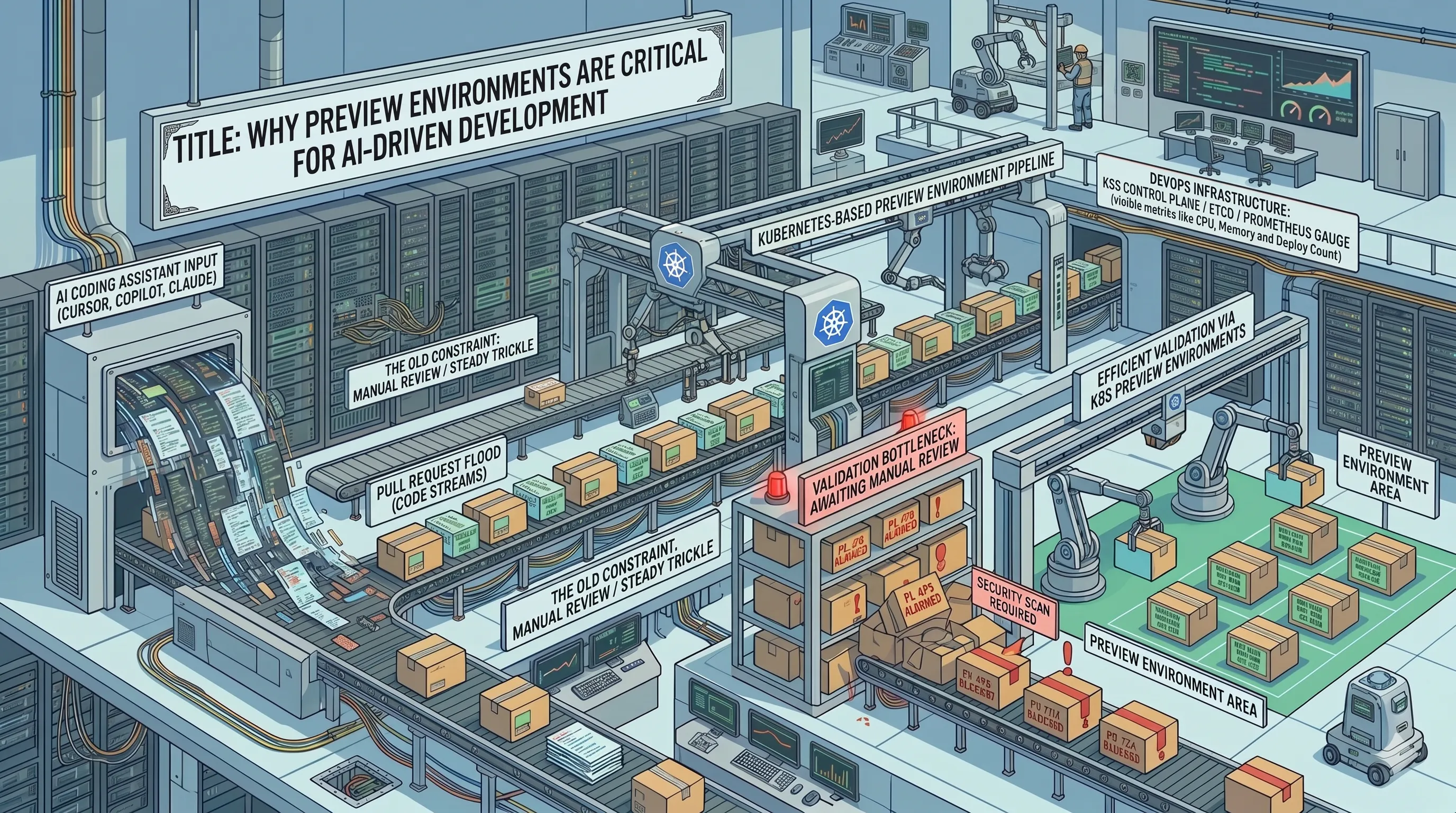
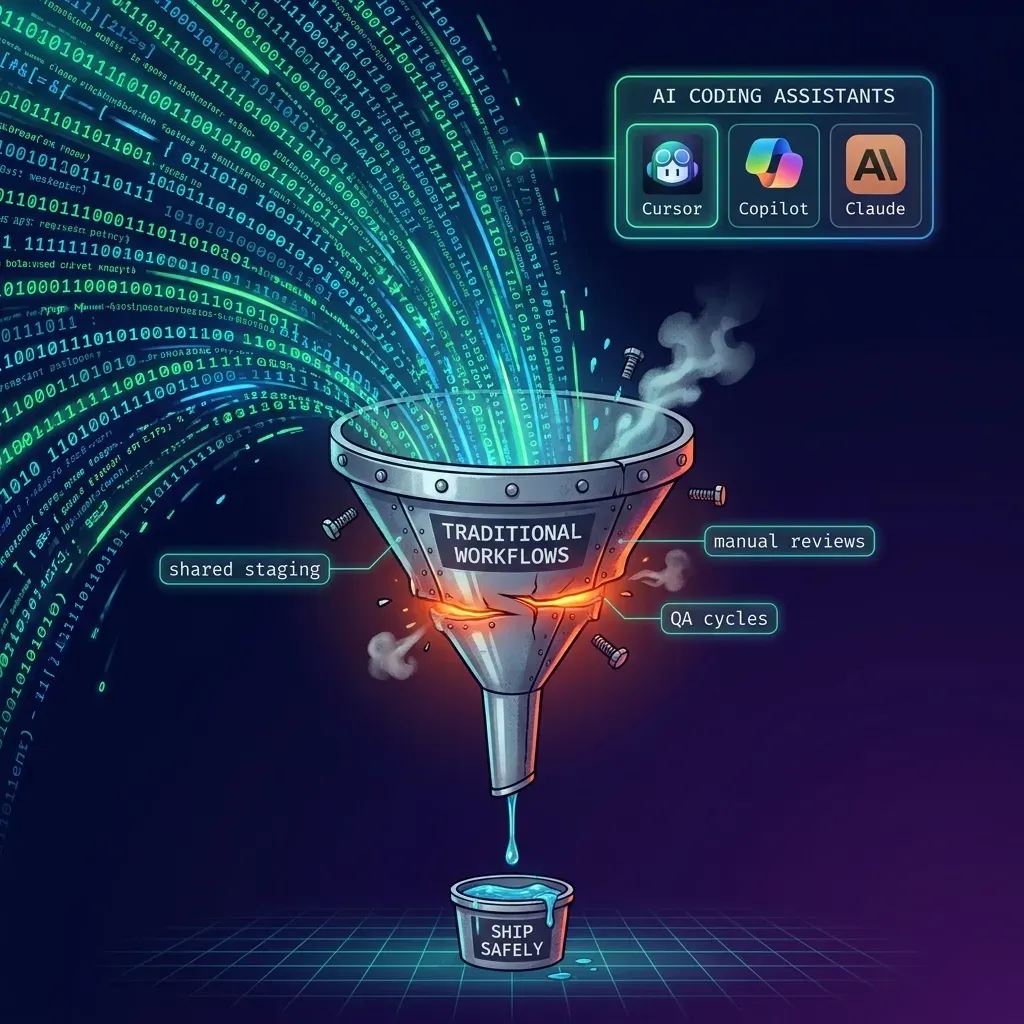
There’s a shift happening on engineering teams that’s easy to miss until it becomes a problem. AI coding assistants (Cursor, Copilot, Claude) have changed the pace of software development. Code that used to take days to write now takes hours. Pull requests that came in at a steady trickle are starting to arrive in floods.
But the rest of the software delivery pipeline is still running at the speed it always did.
The constraint in software development has shifted; it’s how fast you can validate it, review it, and ship it safely. The infrastructure built for the old constraint doesn’t hold up under the new one.
Preview environments are one of the most important tools for closing that gap. But they’re still widely underestimated, treated as a frontend convenience rather than a foundational platform infrastructure for teams building with AI.
AI-Assisted Development Is Breaking Traditional Workflows
When developers write code manually, they’re naturally rate-limited by the effort of writing it. That buffer meant reviews, staging slots, QA cycles could keep pace. AI coding tools remove that buffer.
A developer using Cursor or Copilot isn’t writing one feature per sprint, they’re generating multiple implementations across several threads of work simultaneously. Multiply that across a team and the volume of changes in flight at any given moment increases dramatically.
But the downstream processes stay the same. Staging environments are still shared, sequential, and finite. Review cycles still take the same calendar time.
The result is a growing imbalance: code generation speed increases while validation throughput stays flat. Teams that don’t address this operationally will feel it as a quality problem, a velocity problem, or both.
What Preview Environments Actually Are (And What They’re Not)
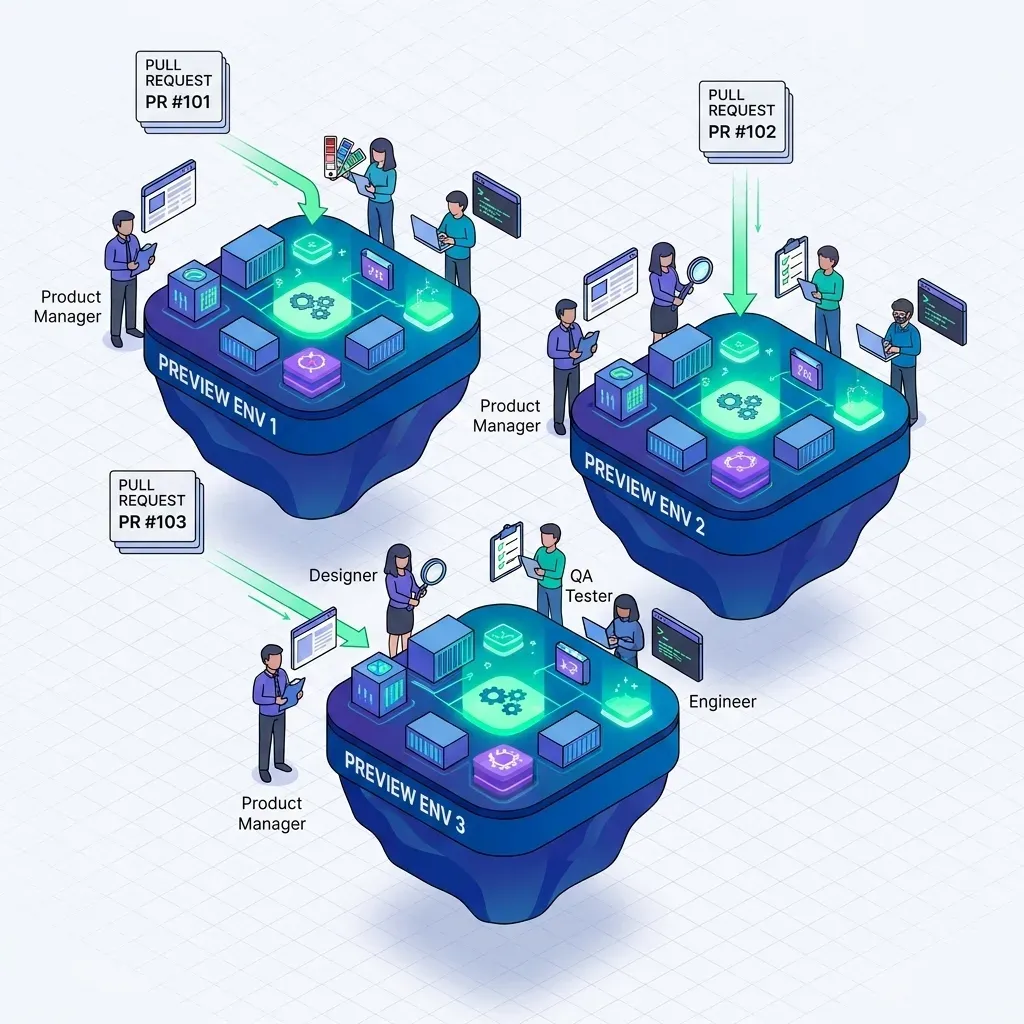
A preview environment is a temporary, isolated deployment created automatically when a pull request is opened. The CI/CD pipeline detects the change and automatically triggers a workflow that typically looks like this:
- Provisions a dedicated environment.
- Deploys the change.
- Generates a shareable URL for testing and review.
This allows anyone to interact with a real, running version of the change.
Vercel and Netlify made this pattern mainstream for frontend teams, and it’s easy to see why.
But preview environments are not about cloning entire systems. At scale, that would be impractical. Instead, they focus on:
- Deploying only the services that changed.
- Connecting them to existing, stable dependencies.
- Providing enough context to validate behavior realistically.
This is why they’re increasingly relevant beyond frontend use cases.
For platform engineering teams on Kubernetes, a targeted contextual deployment can:
- Validate microservice changes in isolation.
- Test API behavior against live dependencies.
- Simulate real integration scenarios without touching staging.
These tasks require isolated, shareable validation.
The Hidden Bottleneck: Who Reviews AI-Generated Features?
When AI tools accelerate code generation, the bottleneck shifts to review and validation. And increasingly, the people who need to validate software changes are not engineers.
Product managers, designers, and stakeholders are now on the critical path. They need to validate user experience and feature correctness, but they can’t review code.
Without preview environments, non-technical reviewers are stuck waiting for a shared staging environment that’s often broken or occupied by something else. They are left with giving feedback on mockups rather than live interaction with actual code. None of that scales.
Preview environments solve this by becoming the shared reality between technical and non-technical collaborators. Reviewers get a link, click it, and see exactly what the developer built. The feedback loop closes at the speed of the work.
Slow Feedback Loops Kill AI’s Advantage
If an AI tool generates a working UI in thirty seconds, but takes two hours for someone to set up a local environment to validate it, most of that advantage disappears. This is what continuous feedback actually means in the context of AI-driven development. It’s not just a CI/CD principle, it’s an operational requirement for preserving the velocity that AI tools create.
The same logic applies to backend changes. If a new API endpoint requires waiting for a staging slot or breaking a shared environment that ten other developers rely on, the feedback cycle stretches to days.
Preview environments break the queue. Each change gets its own environment, deployed in parallel, reviewable as soon as the pipeline completes.
No setup, no waiting, no broken shared state.
This is how preview environments preserve the speed advantage of AI-assisted development rather than letting it drain away at the review stage.
From Convenience to Governance Layer
There’s a deeper reason preview environments matter for AI-assisted development, one that goes beyond throughput and review speed.
Nobody fully trusts vibe-coded output. AI-generated code can be functional, coherent, and entirely wrong in ways that only become visible when it’s actually running against real dependencies. Confident generation is not the same as correct behavior.
Preview environments create a verifiable checkpoint. Before any change reaches a shared environment, it has to run in isolation first. That isolation is what transforms preview environments from a developer convenience into a governance layer.
At scale, this enables parallelism: many developers and AI agents can test simultaneously without stepping on each other. Each change has its own environment, its own lifecycle, its own point of feedback. No more sequential review through a shared bottleneck, but concurrent validation across independent environments.
Without it, teams face a binary choice that becomes increasingly uncomfortable as AI-assisted development scales: slow down to add manual checkpoints, or accept the integration risk of moving fast without them. Preview environments are how you avoid having to choose.
What It Takes to Run Preview Environments at Scale
Preview environments for complex backend systems and Kubernetes platforms require more than a simple PR deployment hook. The gap between a working proof of concept and a production-grade implementation is where most teams underestimate the investment.
Three platform capabilities are key for operating preview environments:
- GitOps-driven workflows to manage state declaratively.
- Automated provisioning across cloud and Kubernetes environments.
- Platform abstractions that hide complexity from developers.
At scale, the operational challenges multiply:
- Environment lifecycle management: when do environments spin up, when do they tear down, and who controls that?
- Access control: who can see a preview environment, and how is that enforced?
- Capacity management: how do you prevent a flood of PRs from exhausting cluster resources?
- Multi-service coordination: how do you test a change to one service against live versions of everything it depends on?
These are solvable problems with the right patterns. In the next part of this series, we’ll explore:
- Patterns and operational practices for running preview environments reliably in production Kubernetes environments.
- Antipatterns that create more problems than they solve.
- Architectural decisions that determine whether preview environments become leverage or liability.